
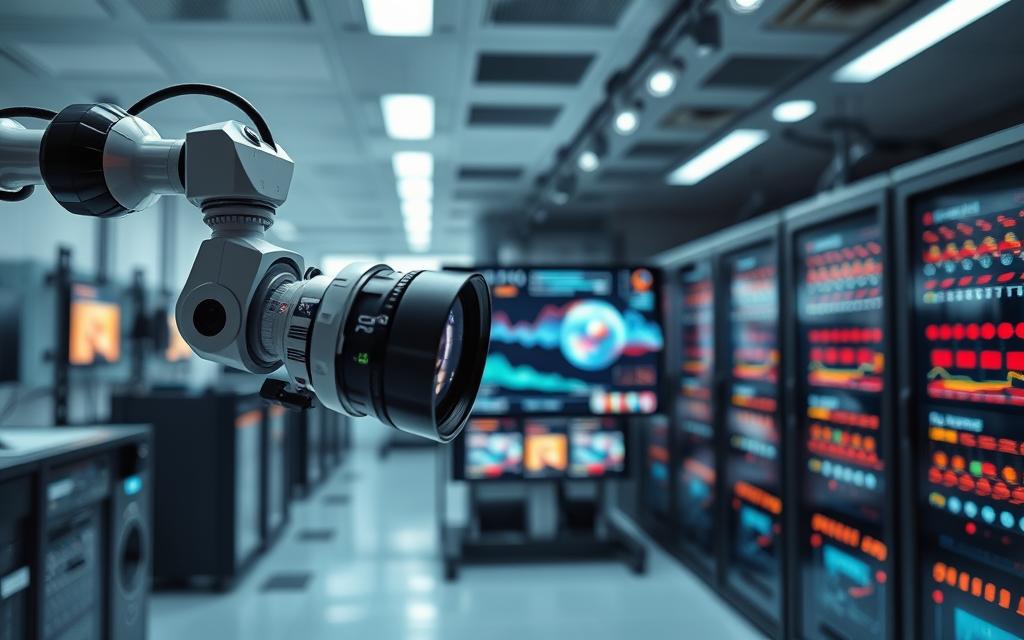

Modern systems now analyse visual data with precision once exclusive to human sight. This capability stems from advanced machine learning techniques that decode patterns in pixels. Through layered algorithms, devices interpret everything from handwritten text to complex industrial defects.
The practical uses span industries. Medical teams employ these tools to spot tumours in scans faster than manual reviews. Manufacturers detect microscopic flaws on production lines, reducing waste. Even transport networks rely on such innovations – self-driving cars navigate roads by processing live camera feeds.
At its core, this technology forms part of computer vision, a branch of artificial intelligence focused on replicating visual comprehension. Unlike basic photo filters, true image recognition identifies objects contextually. It distinguishes a pedestrian from a lamppost, or a defective component from a functional one.
From retail security to agricultural monitoring, applications demonstrate how machines transform raw visuals into actionable insights. This evolution reshapes problem-solving – offering speed and accuracy unachievable through human effort alone.
Introduction to Image Recognition
Pixels, each with unique intensity values, serve as building blocks for machine interpretation. These tiny colour-coded squares form grids that systems translate into actionable insights. Early researchers discovered that numeric representations of light could teach machines to identify shapes, textures, and objects.
Overview of Computer Vision
Computer vision, a subset of artificial intelligence, enables devices to process visual data. It handles three primary tasks:
- Detecting objects in cluttered environments
- Classifying elements within scenes
- Mapping spatial relationships between items
This field extends beyond basic photo analysis, allowing systems to interpret context – like distinguishing emergency vehicles from regular cars.
The Evolution of Visual Technology
Lawrence Roberts revolutionised the field in 1963 by modelling 3D object perception. His work laid the groundwork for modern image recognition tools. Breakthroughs accelerated with two developments:
- High-resolution scanners (1970s)
- Convolutional Neural Networks (2010s)
By 2015, deep learning algorithms achieved over 95% accuracy in visual tasks. This leap stemmed from combining vast data sets with advanced processing power, transforming computer vision from theory to real-world solutions.
What is image recognition in machine learning
Digital systems decode visual information through layered computational processes. By mapping relationships between pixels, algorithms detect recurring structures and assign them contextual meaning. This approach enables devices to categorise elements within photographs, scans, or live video feeds.
Defining the Core Concepts
At its foundation, visual analysis relies on pattern identification. Systems convert colour gradients and shapes into mathematical models, enabling consistent classification of objects across varied scenarios. A street sign recognition tool, for instance, distinguishes triangular warnings from circular directives regardless of weather conditions.
Two primary methodologies govern this field:
| Approach | Data Requirements | Typical Applications |
|---|---|---|
| Supervised Learning | Labelled datasets | Medical diagnostics |
| Unsupervised Learning | Raw visual inputs | Anomaly detection |
The first method trains models using pre-categorised examples, perfect for identifying known objects like specific vehicle models. The second technique discovers hidden patterns autonomously, useful in spotting manufacturing defects without prior examples. Both strategies transform pixel arrays into decision-ready outputs through systematic feature extraction.
The Technology Behind Image Recognition
At the heart of modern visual analysis lie sophisticated algorithms that mimic neural processes. These systems decode patterns through convolutional neural networks (CNNs) – multi-layered architectures designed to process pixel-based data hierarchically. Unlike traditional methods, this approach automates feature discovery, eliminating manual input.
Convolutional Neural Networks in Action
CNNs employ convolutional layers with mathematical filters that slide across images. These detect basic elements like edges or curves in early stages. Subsequent layers assemble these components into complex shapes – a car’s wheel or a bird’s wing.
Key architectural components include:
| Layer Type | Function | Output Impact |
|---|---|---|
| Convolutional | Pattern detection | Identifies local features |
| Pooling | Dimensionality reduction | Preserves critical data |
| Fully Connected | Classification | Generates predictions |
Pooling layers streamline computations by downsampling spatial information. This step maintains essential features while reducing processing demands. Final classification occurs in dense layers that correlate learned patterns with target labels.
Through deep learning, these models self-optimise during training. Exposure to millions of labelled images allows networks to refine their filters – transforming raw pixels into actionable insights without human guidance.
Pre-processing and Feature Extraction Techniques
Raw visual inputs undergo meticulous refinement before analysis begins. This stage converts chaotic pixel arrangements into structured data that algorithms can interpret effectively. Without these preparatory steps, even advanced systems struggle to identify meaningful features.

Image Normalisation and Rescaling
Engineers standardise images through pixel value adjustments. Common practices include:
- Scaling colour intensities to 0-1 ranges
- Resizing pictures to uniform dimensions
- Applying Gaussian filters to eliminate visual noise
| Technique | Purpose | Benefit |
|---|---|---|
| Grayscale Conversion | Simplify colour channels | Reduces processing demands |
| Histogram Equalisation | Enhance contrast | Improves feature visibility |
| Normalisation | Standardise input ranges | Prevents model bias |
Feature Annotation and Extraction
Labelled training data teaches systems to recognise objects. Annotators mark specific elements – like animal shapes in wildlife photos – creating reference points for algorithms.
Feature extraction transforms visuals into numerical formats. Traditional methods use edge detection or texture analysis, while deep learning models automate this process. Consider how systems differentiate vehicle types:
| Method | Process | Use Case |
|---|---|---|
| Manual | Engineer-defined parameters | Basic shape recognition |
| Automatic | Neural network discovery | Complex pattern detection |
Proper training relies on high-quality annotations. Well-prepared data enables models to isolate critical features, whether analysing medical scans or retail product displays.
Comparing Traditional Machine Learning and Deep Learning
Visual analysis methods have evolved through two distinct pathways. Traditional approaches rely on human-guided processes, while modern systems harness self-improving architectures. This divergence fundamentally alters how devices interpret visual information.
Traditional Algorithms Explained
Classical machine learning algorithms require engineers to manually define features like edges or textures. Techniques such as Support Vector Machines analyse histograms of oriented gradients, while SIFT matches keypoints through pixel comparisons. These methods demand:
- Domain expertise to identify relevant patterns
- Pre-processed datasets with labelled examples
- Computationally lightweight frameworks
Such approaches excel in scenarios with limited data or hardware constraints. A factory using basic defect detection might prefer these algorithms for their simplicity and speed.
Advantages of Deep Learning Models
Deep learning revolutionised visual analysis by automating feature discovery. Multi-layered neural networks progressively learn from raw pixels, identifying complex patterns invisible to human engineers. Key benefits include:
- Automatic extraction of hierarchical features
- Superior accuracy in large-scale applications
- Adaptability to novel visual scenarios
However, these models require substantial computational resources and training data. As one researcher noted:
“Deep learning trades manual effort for exponential gains in recognition capability”
The choice between approaches hinges on specific needs. Traditional machine learning algorithms suit resource-limited environments, while deep learning dominates complex tasks like real-time object tracking or medical scan analysis.
Real-world Applications of Image Recognition
Visual analysis tools now permeate daily life and industrial operations, solving challenges through precise object detection. From unlocking smartphones to safeguarding cities, these systems deliver tangible benefits across sectors.

Facial Recognition and Security Systems
Over 85% of UK smartphones use facial recognition for biometric authentication. This technology maps unique facial features through infrared sensors, creating secure digital keys. Beyond personal devices, authorities employ these systems to:
- Identify suspects in CCTV video feeds
- Monitor crowd movements at transport hubs
- Prevent unauthorised access to restricted areas
| Application | Detection Method | Accuracy Rate |
|---|---|---|
| Phone Unlocking | 3D Depth Mapping | 99.8% |
| Surveillance | Real-time Video Analysis | 97.4% |
Medical Imaging and Industrial Inspection
In healthcare, medical imaging systems spot tumours 30% faster than manual reviews. Radiologists use AI-powered tools to flag abnormalities in X-rays, prioritising urgent cases. Industrial sectors apply similar principles:
| Industry | Use Case | Defect Detection Rate |
|---|---|---|
| Pharmaceuticals | Tablet Quality Control | 99.9% |
| Automotive | Paint Imperfection Analysis | 98.6% |
These technologies excel in repetitive tasks, maintaining consistency across thousands of inspections daily. Retailers similarly leverage object detection for stock management, using shelf cameras to track inventory levels automatically.
Challenges and Limitations in Image Recognition
Real-world environments test the limits of visual analysis systems through unpredictable variables. Despite advances, several factors hinder consistent accuracy across diverse scenarios.

Impact of Lighting Variations and Data Quality
Lighting inconsistencies rank among the top disruptors for image recognition systems. Bright glare can erase texture details, while shadows may distort an object’s contours. Low-light conditions force models to interpret noisy pixel patterns, increasing error rates by up to 40% in some studies.
Training data quality directly affects performance. Systems exposed only to studio-lit, high-resolution images often falter with grainy security footage or sun-washed drone captures. A model trained exclusively on daylight street scenes might misclassify vehicles in foggy conditions.
Key challenges include:
- Overexposure washing out critical edges
- Dataset biases towards idealised visuals
- Limited adaptability to dynamic environments
Addressing these issues requires strategic approaches to training data collection. Diversified datasets containing imperfect, real-world content help systems generalise better across lighting scenarios. Advanced preprocessing techniques also compensate for poor illumination during live analysis.
Innovations and Future Trends in Computer Vision
Breakthroughs in computational power are pushing visual analysis beyond current limitations. Augmented reality applications now extend to smart glasses that overlay contextual data onto real-world environments – from navigation cues to product information. These developments signal a shift towards computer vision systems that interact seamlessly with human perception.
Enhancing Model Accuracy with Advanced AI
Next-generation models address accuracy gaps through synthetic data generation. Engineers create hyper-realistic training scenarios using 3D simulations, reducing reliance on imperfect real-world captures. Techniques like federated learning allow machines to refine algorithms across distributed devices while maintaining privacy.
Emerging Trends and Technological Breakthroughs
Edge computing enables real-time recognition technology in resource-limited settings. Factories deploy on-site systems that inspect products without cloud dependencies. Meanwhile, neuromorphic chips mimic biological neural networks, slashing power demands for complex vision tasks.
The trajectory points towards ethical computer vision frameworks. Researchers prioritise bias mitigation in models, ensuring fair outcomes across diverse demographics. As these technologies mature, they’ll redefine how machines enhance human capabilities rather than simply replicating them.


 By
By