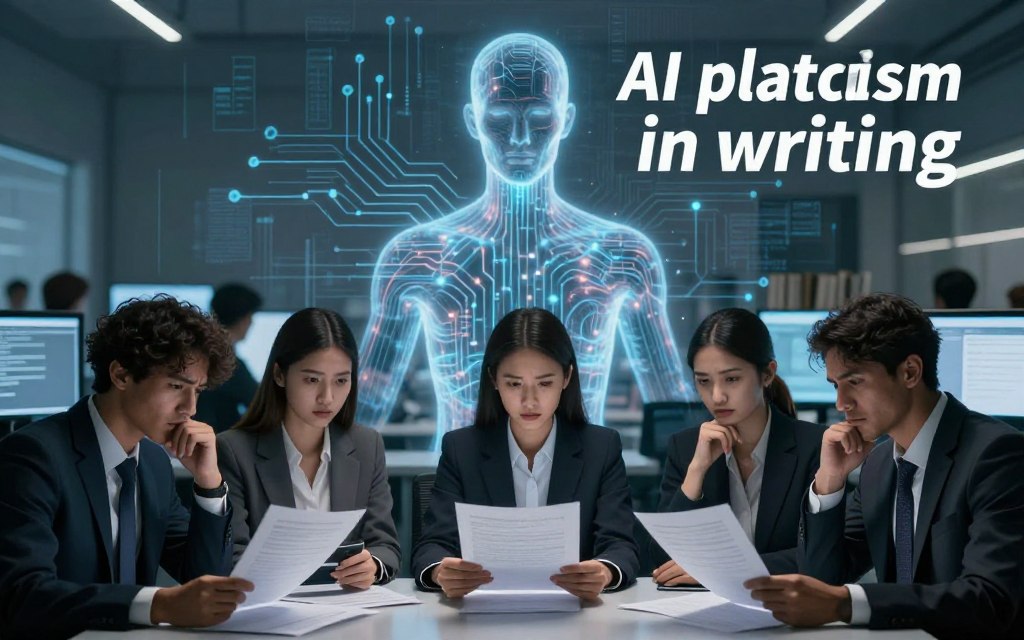

Today, many people ask: is it plagiarism to use AI in writing? The answer depends on how you use the tool, your involvement, and whether you disclose its help. This issue matters to anyone using AI in writing.
You must distinguish AI-generated content, copyright infringement, and academic misconduct. Each has different rules and guidelines. Review the plagiarism rules from your school, employer, publisher, or client because they may differ.
This article offers practical guidance about AI risks, including proper attribution and citation formats. These steps can help you understand AI plagiarism and use AI responsibly in your writing.
Key Takeaways
- Understanding AI’s role in writing is essential for ethical practices.
- Disclosing AI assistance can help avoid potential issues.
- Review institutional policies regarding AI-generated content.
- Differentiate between plagiarism and acceptable AI use.
- Proper citation is crucial when using AI tools.
Understanding AI-Generated Content and Plagiarism
As AI technology evolves, content creation and plagiarism become more complex. Understanding their relationship matters to anyone who writes or produces content.
What Is AI-Generated Content?
What is AI-generated content? It is text, images, code, audio, or other material produced or greatly changed by artificial intelligence after user instructions. AI writing tools can create articles, essays, and other written forms from specific prompts.
Defining Plagiarism in the Digital Age
The definition of plagiarism covers presenting another person’s words, ideas, structure, or creative work as your own without proper acknowledgment. Plagiarism in the digital age also includes content generated by AI.
Traditional vs. Modern Definitions
Traditional plagiarism focused mainly on copying text word for word. Modern definitions also address generative systems, paraphrasing, and fabricated citations. This change reflects AI’s growing power and its challenges for original authorship.
The Role of Intent in Plagiarism
Intent strongly affects how people assess plagiarism. Deliberate deception can bring severe consequences in academic and professional settings, while accidental misuse of AI-generated content may still violate policies. The standard depends on the assignment, organization, and jurisdiction.
| Aspect | Traditional Definition | Modern Definition |
|---|---|---|
| Focus | Copying text directly | Includes paraphrasing and AI-generated content |
| Intent | Deliberate copying | Accidental misuse also considered |
| Consequences | Academic penalties | Broader implications in professional settings |
Is It Plagiarism to Use AI? The Direct Answer
The answer to “is it plagiarism to use AI” depends on the context and your intent. AI use is not always plagiarism, but certain actions can create serious problems. Anyone using AI should understand these important differences.
When AI Use Becomes Plagiarism
Learn when AI use is plagiarism. One major concern is submitting AI-generated work as entirely original. This practice can lead to academic misconduct accusations or misrepresent who created the work.
Submitting AI Output as Original Work
Presenting AI output as your own, without changes or personal ideas, can cause problems. It misleads readers and violates ethical standards in academic and professional settings.
Failing to Disclose AI Assistance
Another concern is failing to disclose AI assistance. If your school or organization requires transparency, hiding this help can lead to serious consequences.
When AI Use Is Acceptable
There are also situations that allow acceptable AI use. Using AI for brainstorming can support creativity and produce new ideas without crossing ethical lines.
AI as a Brainstorming Tool
AI can help generate topics, create questions, or organize notes. You can use this technology while keeping your own voice and analysis.
Editing and Refining AI Suggestions
Editing AI-generated responses can help keep your work original. However, rephrasing AI output alone is not enough. Add real reasoning, check accuracy, and follow attribution rules.
Use a practical test to manage AI use. Identify what AI contributed, check whether the rules allow it, document the process, and disclose or cite it when required.
Academic Rules and Policies on AI Usage
As AI becomes more common, colleges are revising policies about its effects on academic integrity. Each institution creates unique guidelines that reflect its values and educational philosophy. Understanding an academic AI policy helps students, faculty, and researchers act responsibly.
University and College Guidelines in the United States
Many universities and colleges in the United States have specific rules for using AI tools. Some allow limited use for brainstorming or editing, but they often ban AI-generated content in assessed work. These university AI rules help protect academic integrity.
Students should check their syllabus, assignment instructions, and honor code before using AI tools. Understanding the specific college plagiarism policy can prevent unintentional violations. Departments may also have their own guidelines, so students must stay informed.
Turnitin and AI Detection Tools
Turnitin AI detection and similar tools assess submissions for originality and may identify AI-generated content. However, their scores only offer clues and do not prove plagiarism. False positives and negatives can occur, so context matters.
These tools are useful but should not be the sole measure of academic honesty. Educators and students should understand their limits and use a broader approach to academic integrity.
Publisher and Journal Policies
In scholarly publishing, AI policies are also changing. Major academic publishers now distinguish language editing tools from tools that generate substantive content. Many do not recognize AI systems as authors and may require disclosures in acknowledgments or methods sections.
Researchers should verify the current journal AI policy of each publication before submitting, because requirements can change. Understanding publisher AI guidelines helps researchers comply and maintain credibility in academic work.
Major Academic Publishers’ Stances
| Publisher | AI Usage Policy | Disclosure Requirements |
|---|---|---|
| Springer | Allows AI for editing; prohibits content generation | Disclosure in acknowledgments |
| Elsevier | Permits AI tools for language assistance | Disclosure required in methods section |
| Wiley | Prohibits AI-generated content | None specified |
As academic institutions and publishers address AI’s complexities, all stakeholders must stay informed. Consulting institutional policies and publisher guidelines supports responsible, ethical AI use in academic settings.
Copyright and Intellectual Property Considerations
AI copyright shows how intellectual property and AI affect creators and users. Ownership of AI-generated content matters to both groups. Plagiarism concerns credit and honesty, while copyright covers legal ownership and copying.
Ownership of AI-generated content remains a gray area in law. The U.S. Copyright Office AI guidance says copyright protection requires human authorship. Works created only by AI may not qualify, so applicants may need to identify and disclaim AI-generated portions when registering their works.
Who Owns AI-Generated Content?
Ownership of AI-generated content can depend on human involvement during creation. Human selection, arrangement, or changes to AI output may support copyright protection. Purely AI-generated works without meaningful human input face major legal barriers.
Legal Precedents and U.S. Copyright Office Guidance
In Thaler v. Perlmutter, the court ruled that works without human authorship lack copyright protection under current U.S. law. The decision shows why human creativity matters in copyright law. Stay informed about how these rulings may affect ownership of AI-generated works.
The Thaler v. Perlmutter Case
The Thaler v. Perlmutter case shows the legal rules for AI-generated content. The court said copyright law requires a human author for protection. As AI advances, the law may change; seek legal counsel for commercial or high-value works involving AI-generated content.
Risks of Using AI Without Proper Attribution
Using AI without acknowledgment can cause many consequences. The effects of failing to credit AI-generated content depend on the setting and institutional policies. In academic and professional settings, the risks of AI plagiarism can cause serious problems.
A major concern is academic misconduct. Students may face failing grades, rejected assignments, or expulsion from their programs. Schools often enforce strict plagiarism rules, while professional consequences of AI use may include employment actions or contract disputes.
Academic and Professional Consequences
In academic settings, failing to credit AI contributions can have serious results. A student may receive a failing grade or face discipline that harms their academic record. This outcome can cause lost scholarships or other academic opportunities.
In professional settings, the risks are just as serious. An author might have a manuscript withdrawn because of concerns about AI attribution. Employers may act against employees who break ethical standards, causing job loss or reputational harm.
Reputational and Career Damage
Reputation damage is another serious risk of using AI without proper attribution. Colleagues, clients, and audiences may lose confidence when people cannot explain or defend their work. This loss of trust can limit future collaborations and opportunities.
Loss of Credibility in Your Field
Ultimately, failing to document AI use openly can cause a major loss of credibility in one’s field. Without proper attribution, peers may become skeptical, damaging a professional image. In an age when integrity and transparency matter, responsible AI use remains essential.
Inaccurate AI output, fabricated references, and biased language can make these risks worse. To reduce fallout, users should review content carefully and document AI contributions clearly. Relying only on AI detection avoidance or hiding these tools can create greater problems later.
How to Use AI Responsibly and Ethically
Using AI well takes care and clear rules. Ethical AI writing protects your work as AI tools change.
Using AI as a Research and Drafting Assistant
An AI research assistant can help you brainstorm ideas, outline projects, and summarize information. Before using AI, define your task clearly and decide what you want to achieve. You may want ideas or help refining existing content.
Never enter confidential or proprietary information into AI systems. Human oversight helps you follow rules from your school or employer.
Maintaining Original Thought and Voice
AI may offer suggestions, but you must keep your unique voice and perspective. Treat AI content as a draft, not a final product. Add your insights and analysis so the final work reflects your thoughts and style.
Adding Personal Insights and Analysis
Your insights matter when you use AI. Think critically about the information it provides. Ask how the information matches your knowledge and experiences.
This process strengthens your work and supports your authority on the subject.
Fact-Checking AI-Generated Information
Fact-checking AI content is essential. Verify each claim with reliable sources, confirm quotations, and test all data or calculations. This process improves accuracy and helps prevent misinformation.
Keep a record of how you used AI in your projects. Your school, employer, or publisher may request details about your methods. This practice supports the principle of responsible AI use and builds your credibility as a writer.
| AI Use Case | Best Practices | Considerations |
|---|---|---|
| Brainstorming Ideas | Define clear objectives | Avoid sensitive information |
| Drafting Content | Use AI as a starting point | Maintain your voice |
| Fact-Checking | Verify against reliable sources | Cross-check all data |

Best Practices for Citing AI-Generated Content
Learning how to cite AI-generated content supports responsible writing. Knowing how to cite ChatGPT protects academic honesty and your work’s credibility. Your method depends on whether the output is recoverable, quoted, paraphrased, or used for brainstorming.
Citation Formats for Popular AI Tools
These guidelines show how to cite AI-generated content in common styles:
Citing ChatGPT in APA Style
For an APA AI citation, name the tool, add the use date, and describe your prompt. Use this basic format:
OpenAI. (Year). ChatGPT [AI model]. Retrieved from URL
Citing AI Tools in MLA and Chicago Styles
For an MLA AI citation, name the AI system and describe your prompt. It can follow this format:
OpenAI. ChatGPT. “Your prompt here.” Date of access, URL.
For a Chicago AI citation, include the tool, prompt, access date, and URL. Use this format:
OpenAI. ChatGPT. “Your prompt here.” Accessed Month Day, Year. URL.
Transparency With Your Audience
Honest AI use builds trust and supports ethical writing. Consider adding an AI disclosure statement to your work. For example:
This report utilized OpenAI’s ChatGPT for content generation.
Instructors and publishers may set specific citation rules, so check their guidelines. Transparency shows your accountability as a writer, not just a formality.
| Citation Style | Format Example | Notes |
|---|---|---|
| APA | OpenAI. (Year). ChatGPT [AI model]. Retrieved from URL | Include date and prompt details. |
| MLA | OpenAI. ChatGPT. “Your prompt here.” Date of access, URL. | Be descriptive of your use. |
| Chicago | OpenAI. ChatGPT. “Your prompt here.” Accessed Month Day, Year. URL. | Similar to MLA but with access date. |
Common Misconceptions About AI and Plagiarism
In today’s digital world, myths about AI and plagiarism can cause confusion. Understanding them helps people use AI-generated content with care.
Myth: AI Content Is Automatically Original
Many people believe AI-generated content is always original. Yet chatbot text may repeat familiar words or phrases from large datasets. These datasets may contain published material, so output can echo existing work. Even without a direct match, it may break copyright rules or repeat unsupported claims.
Myth: Rewording AI Output Makes It Yours
Some people think paraphrasing AI output creates independent authorship. Changing a few words or asking AI to rephrase does not ensure original work. Surface changes can keep the source’s structure and ideas, creating plagiarism risks. Add genuine insights instead of relying only on AI-generated material.
Myth: AI Detection Tools Are Infallible
Many users think AI tools can prove content is original. These tools help, but they are not perfect. AI detector accuracy can change with writing style, language background, and content type.
These plagiarism detection limitations make sole reliance risky. Follow applicable rules, add meaningful human work, and disclose AI help when needed.
In conclusion, dispelling these AI plagiarism myths supports responsible content creation. Understanding AI’s limits and valuing AI content originality can guide better writing choices. For more insights on AI and plagiarism, read why AI has a plagiarism problem. Then learn to spot AI-generated or human-written content at this resource.
Industry Standards and Future Outlook
The future of AI regulation includes new AI industry standards and policies. As generative AI evolves, many sectors are responding to its effects. Schools, publishers, news organizations, and employers are shaping responsible ways to use AI tools.
Current AI industry standards focus on several key areas:
- Disclosure Requirements: Organizations are beginning to emphasize the need for transparency when using AI-generated content.
- Human Review: Many industries are advocating for human oversight to maintain quality and integrity in AI applications.
- Provenance Records: There is a growing demand for documentation that tracks the origins and modifications of AI-generated materials.
- Data Privacy: Companies are prioritizing the protection of user data in AI processes to comply with regulations.
- Model Transparency: Ensuring that AI models are understandable and accountable is becoming a critical standard.
New rules and AI disclosure trends point toward clearer guidelines for AI use. These changes include federal AI guidelines, generative AI policy, and accountability measures:
- Federal Guidelines: U.S. federal agencies are developing policies to guide the ethical deployment of AI technologies.
- Generative AI Policy: New frameworks are being established to address the unique challenges posed by generative AI.
- Accountability Measures: As AI tools become more capable, ensuring accountability in their use is essential.
Federal Guidelines and Policy Development
Federal AI guidelines help shape responsible AI practices in the United States. They address AI-related challenges and risks while promoting ethical and effective tool use. As rules change, people and organizations should follow agency announcements and updates.
AI is changing quickly, but transparent human oversight will likely remain central. Anyone involved in the AI field must track AI industry standards and regulatory developments.
Conclusion
Understanding AI plagiarism rules matters to anyone who uses AI tools for writing. Using AI is not automatically plagiarism. It becomes a concern when use is hidden or against established guidelines. This can cause academic misconduct or professional ethics breaches.
For responsible use of AI, learn the specific rules for your assignment or workplace. Always contribute original thought, verify AI claims, protect confidential information, and record significant assistance from AI tools.
Disclose AI use whenever required. This transparency supports AI writing ethics and helps maintain your audience’s trust. A practical checklist can ask what the AI tool contributed and whether its use was allowed. Then ask how you verified its output and how to acknowledge the assistance.
These guidelines help you navigate AI in writing with confidence. The question, is it plagiarism to use AI, has a clear answer when you follow responsible practices.


 By
By